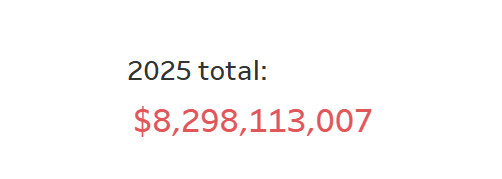
Global competition watchdogs have levied almost $115 million in penalties this year for gun-jumping and related merger review breaches, according to data compiled by Competition.Today.
This year, the authorities on average have imposed close to $13 million a month, underscoring their continued focus on pre-closing conduct.
So far, regulators worldwide have sanctioned 21 cases of merger breaches, totaling $114,832,409 in fines. One additional case remains unresolved, with the Austrian Cartel Court yet to rule on the penalty and its amount.
All but two cases concerned gun-jumping, with commitment-breach fines totaling $32.1 million — nearly a third of the overall $115 million.

According to Competition.Today’s data, merger review penalties were issued in 11 jurisdictions in 2025, with six regulators handing down multiple fines. Spain tops the list with five cases, followed by Brazil and Indonesia with three each. Austria, China, and Denmark imposed two fines apiece.

In terms of fines, Austria dominates the gun-jumping landscape, with its competition authority having imposed fines exceeding $72 million, accounting for nearly two-thirds of the global tally so far. Spain, the leader in the number of enforcement actions, ranks second with penalties of $23.4 million; South Korea follows with $8.7 million.
The United States also features prominently, with fines of $5.6 million, ahead of Denmark ($1.45 million) and Brazil ($1.41 million). At the lower end of the scale, Argentina, Slovakia, Turkey, China, and Indonesia each imposed fines of less than half a million dollars.

Case Highlights: Biggest Fines of 2025
The four largest fines highlight both the scale of penalties and the diversity of enforcement approaches across jurisdictions.
In the United States, three oil producers — XCL Resources, Verdun Oil, and EP Energy — were fined a record $5.6 million after regulators found they integrated operations before the completion of Verdun’s $1.4 billion acquisition of EP. Authorities said the companies acted as if the merger had already closed, suspending drilling plans and aligning pricing during a period of soaring fuel costs.
Meanwhile, Austria’s Higher Cartel Court imposed the single largest sanction of the year: a €70 million ($72.3 million) fine against REWE International. The ruling ended a years-long dispute over a shopping center lease that the court ultimately deemed a notifiable merger. The penalty, dramatically increased from an earlier €1.5m, underscored the seriousness of failing to comply with notification rules.
In Spain, the competition watchdog came down heavily on recidivist conduct. Telefónica was ordered to pay €20 million ($23.4 million) for violating commitments linked to its 2015 takeover of pay-TV operator DTS. The CNMC found the telecom giant tied television services to mobile-device contracts with punitive exit clauses between 2021 and 2023, a practice already sanctioned two years earlier.
Similarly, South Korea’s KFTC fined Asiana Airlines 12.1 billion won ($8.7 million) for breaching fare-cap conditions tied to its merger with Korean Air. By raising ticket prices above permitted thresholds, Asiana was found to have abused its strengthened market position. The regulator described the conduct as particularly serious and referred the airline for criminal prosecution.
Rising Wave of Enforcement
The 2025 figures underline how seriously regulators treat violations of merger rules, from procedural missteps to breaches of post-merger commitments. Authorities in Europe, the Americas, and Asia all escalated their responses, with several cases involving record-setting fines or criminal referrals.
Austria’s €70m penalty against REWE set a new national benchmark, while Spain and South Korea both sanctioned repeat or systemic violations. Even in the United States, where fines are typically more modest, the $5.6 million oil sector case was described as the largest of its kind.

Taken together, the data shows that competition agencies are increasingly willing to penalize companies that treat merger control obligations lightly. With fines averaging nearly $13 million per month, gun-jumping remains firmly in the spotlight — and firms planning deals can expect closer scrutiny than ever.
More deep dives into global antitrust fines are coming next week. Subscribe now to get them delivered straight to your mailbox.
See the full picture on our Global Fines Map